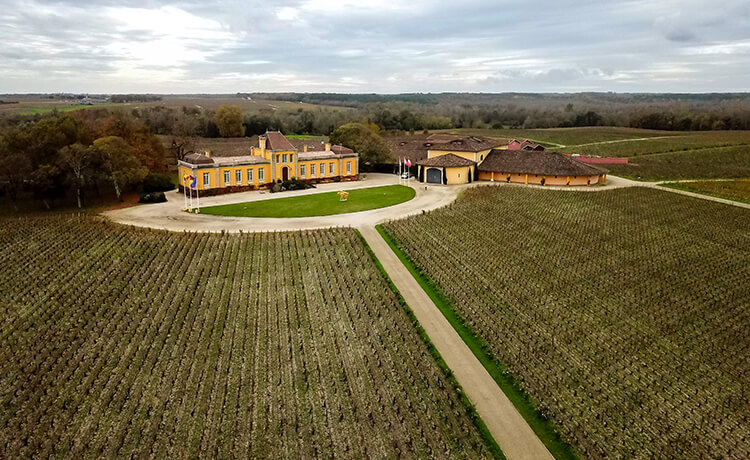
Château Lafon-Rochet is a stand out jewel among the sixty Bordeaux wine estates of the Saint-Estèphe appellation. Tucked just between storied estates like Château Cos d’Estournel and Château Lafite-Rothschild, you can’t miss this 1855 Grand Cru Classé estate with its’ distinct canary yellow 18th century chartreuse style castle as you drive along the enchanting Route des Châteaux.
One of the oldest wine producing château of the Médoc, Château Lafon-Rochet has a history spanning more than 500 years. Embracing both traditional and much needed modernization, the family-owned and run Château Lafon-Rochet is a must visit during any wine tour of Bordeaux.
The History of Château Lafon-Rochet
Château Lafon-Rochet is one of the oldest Bordeaux wine estates with a history of nearly five centuries. Dating back to the 17th century, Château Lafon-Rochet was originally named Domaine Rochet and belonged to the heiress Antoinette de Guillemotes. In 1650, the heiress brought Domaine Rochet as a dowry for her marriage to the Counsellor at the Parliament of Bordeaux, Etienne de Lafon.
The wine estate remained known as Domaine Rochet for more than a century until the heir, Jean Lafon, renamed it to Château Lafon-Rochet. Ultimately, Château Lafon-Rochet was a part of the Lafon family for more than 200 years before it changed hands with a series of new owners seemingly every 20 to 30 years.
A desirable location for grape growing located right between the famed estates of Châteaux Lafite-Rothschild and Cos d’Estournel, Château Lafon-Rochet earned the distinction of Quatrièmes Crus (Fourth Growths) in the 1855 Classification of Bordeaux wines.
In 1960, Guy Tesseron – son of son of Abel Tesseron, who famously founded Cognac Tesseron, took over Château Lafon-Rochet at a very difficult time in Bordeaux. The estate’s buildings had been dilapidated during the war when the château had been producing wine for soldiers and the castle was ravaged by a fire. Tesseron quickly started work to rebuild the estate entirely on the plans of an 18th century chartreuse. In fact, Château Lafon-Rochet is the only 1855 Grand Cru Classé estate with a castle constructed in the 20th century.
By 1970, Guy Tesseron had become a major player in the Bordeaux wine scene and acquired two additional wine châteaux: Château Pontet-Canet and Château Malescasse. A visionary, he worked to make Château Lafon-Rochet a standard among the great wines of Saint-Estèphe over the next 60 years that the château remained within the Tesseron family.
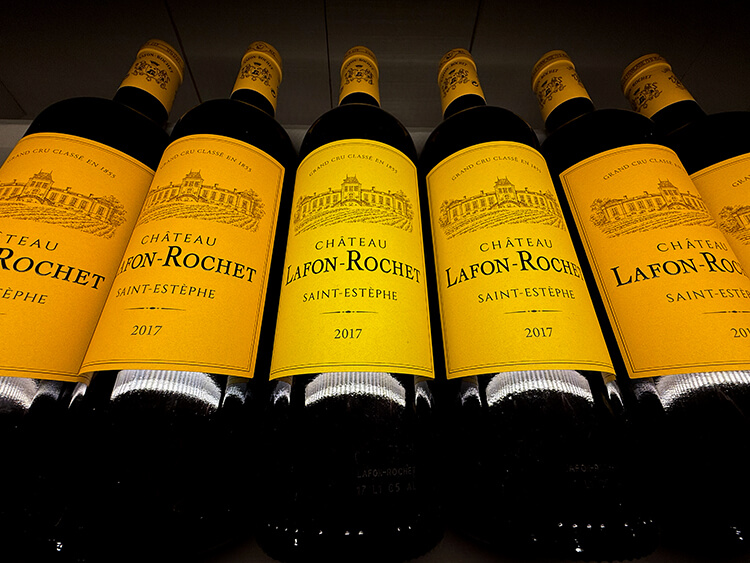
While Château Lafon-Rochet had achieved its’ goals as a stand-out wine maker and grown the vineyard area from just 15 hectares to over 40 hectares, the castle itself was gray and not very visible from the road. It was in 2000 that it was painted the distinct canary yellow color, the from the 2000 vintage the bright yellow color of the castle also appeared on the labels.
Château Lafon-Rochet was sold in 2021 to the Lorenzetti family, owners of Château Lilian Ladouys and Château Pédesclaux in Pauillac. It has remained family-run throughout Château Lafon-Rochet’s more than 500 years of history.
The Visit at Château Lafon-Rochet
Château Lafon-Rochet welcomes visitors to the wine estate year round, but visits are by appointment only and must be reserved in advance.
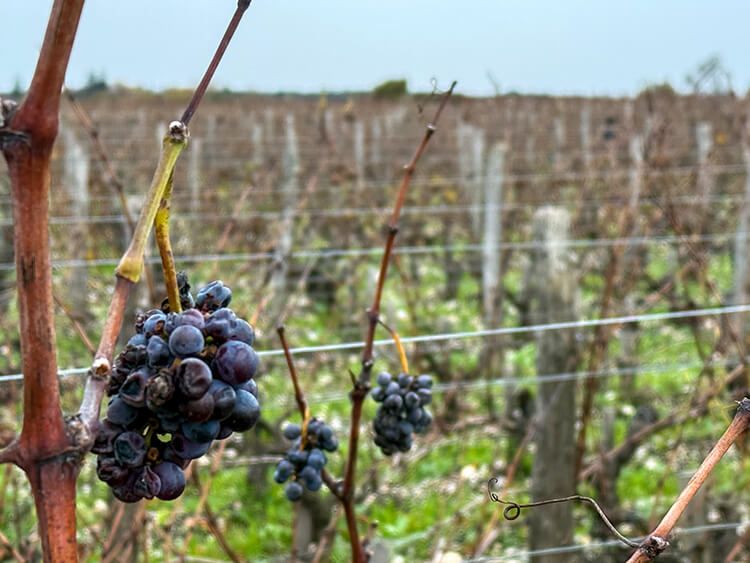
The visit at Château Lafon-Rochet begins where all wine making begins: in the vineyard. The 41 hectares of vineyards, which border the vineyards of the illustrious estates Château Lafite Rothschild and Château Cos d’Estournel, are set in the south-west of the Saint-Estèphe appellation.
The vineyard is planted with 55% cabernet sauvignon, 40% merlot, 3% cabernet franc and 2% petit verdot. The average age of the vines is 38 years, with some historic vines planted more than 80 years ago. The terroir is divided between gravel, which promotes optimal drainage, and clay-limestone that is ideal for water regulation. And what is most unusual, is the the vineyard is almost entirely one large, single parcel of vines. That is nearly unheard of in the Bordeaux wine region.
The grape harvest at Château Lafon-Rochet is entirely manual.

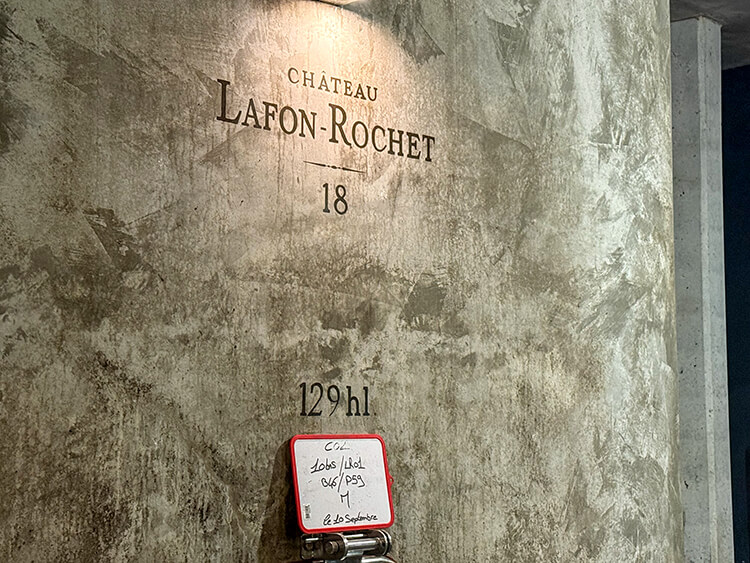
From the vineyards, we move into the vat rooms. The first is the concrete vat room, where more than 70% of the grapes benefit from a malolactic fermentation over a period between 18 and 21 days. The 21 concrete vats were completely refurbished in 2015 and compliment the wine’s barrel aging process.
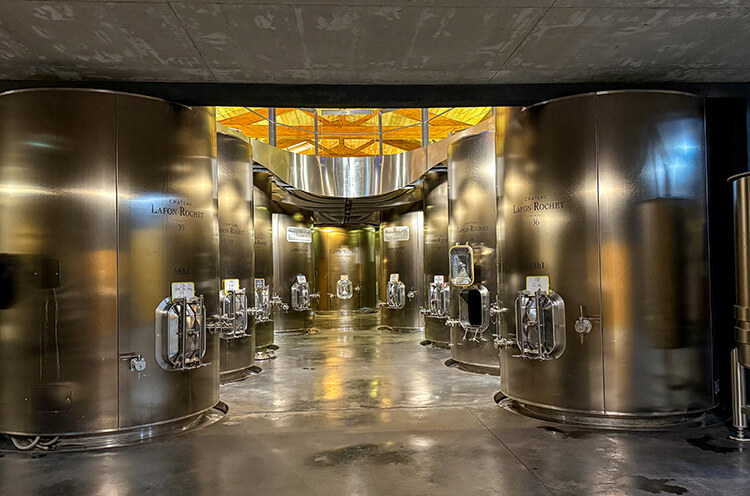
But Château Lafon-Rochet didn’t only refurbish their concrete vats. They also brought in 18 brand new, gleaming stainless steel tanks ranging in size from 50 up to 100 hectoliters.

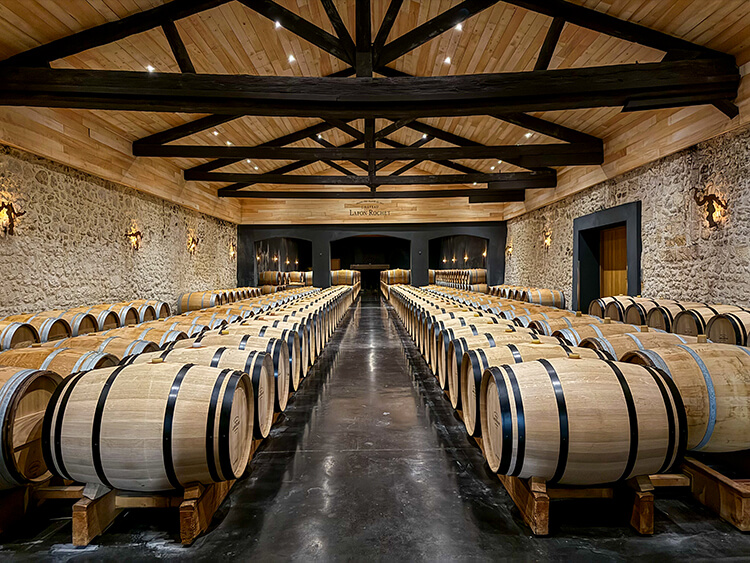
Like with their concrete and stainless steel vat rooms, Château Lafon-Rochet has multiple barrel aging rooms. The wine is aged in carefully selected French oak barrels to achieve subtle notes and complexity to the wine. The wine ages for 12 to 14 months in barrels.
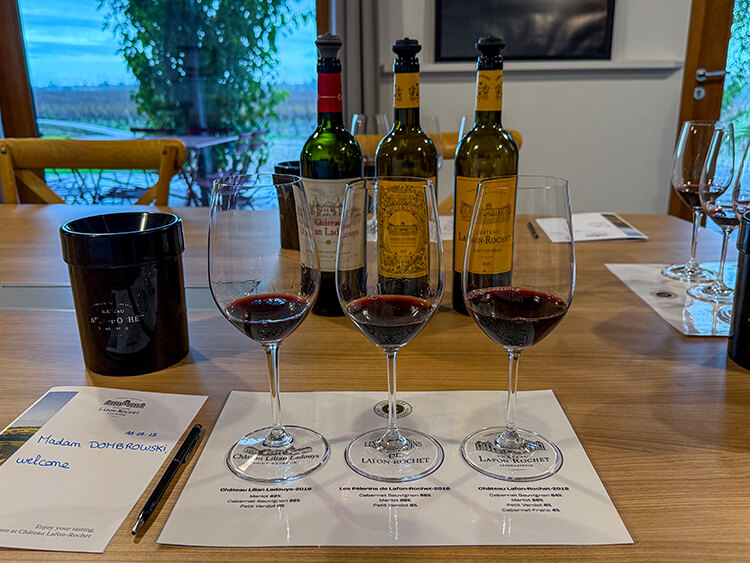
The traditional visit concludes with the tasting of three wines, and visitors receive a small tasting booklet to make notes if you wish. We tasted the Château Lilian Ladouy 2016, the second wine Les Pèlerins de Lafon-Rochet 2016, and Château Lafon-Rochet 2018 during our tasting.
As expected of worthy wines of Saint-Estèphe, the wines have an aromatic bouquet, smooth tannins and achieve a bold and complex finesse.
Know Before You Go
Alternately, you can take the train from Gare Saint Jean to Gare de Pauillac. Then we recommend renting bicycles to ride the 5 kilometers to Château Lafon-Rochet, which is located along a lovely route dotted with the grand castles of the Méoc.
Leave a Reply